

Types of Attachment
Attachment Styles are on a continuum, they are not fixed states
Islands, the Anxiously Avoidant individuals
- have a difficult time shifting from being alone to interacting and do not have difficulty shifting from interacting to being alone (reunion sensitivity)
- have a preference towards autoregulation, coping mechanisms where it is easy to lose time and space (movies, tv, gaming, reading, puzzles, fixing up the house, hiding in a ‘man cave’ or ‘woman cave,’ masturbating, sex in a way that views other as an object rather than a partner of engagement)
- have a tendency towards perfectionism, care about ‘looking good,’ task-oriented, success-driven
- don’t like asking for help, being emotionally vulnerable
- passive aggressive (cold anger)
- when in conflict, wants to move on, gets dismissive: “The past is in the past, get over it!”
Waves, the Anxiously Ambivalent individuals
- have a difficult time shifting from interacting to being alone and do not have difficulty shifting from being alone to interacting with others (departure sensitivity)
- have a preference towards one-way external regulation where someone else helps them feel better
- have a tendency towards codependency: driven by need to maintain connection
- don’t like feeling like the problem
- critical attacks (hot anger)
- when in conflict, gets preoccupied: “I’m not done with this yet…”
Anchor, the Secure individuals
- capable of flowing back and forth between alone time and social interacting
- have a preference for self-regulation, responsive to co-regulation
- driven by guilt: standards of mutuality, sensitivity, fairness
- effective verbal and nonverbal social skills
- when in conflict, stays collaborative
Kinds of Regulation
- Autoregulation is when someone eases their nervous system through an activity on their own where it is easy to lose a sense of time and space (movies, tv, gaming, reading, masturbating, sex in a way that views the other as an object rather than a partner of engagement)
- External Regulation occurs in a one-way interaction where someone else calms a person (Mother nursing baby, nurse bandaging injury, being read to, being sung to, being fed)
- Interactive Regulation, also called co-regulation is an experience we begin at birth and is our ability to correct our connection with others after a relational injury or misstep (friendly gazing, attuned touch)
- Self-regulation is something we learn as we age and requires impulse control, frustration tolerance, emotion regulation, and patience (maintain out breath in stressful social engagement, friendly eye contact, ability to modulate tone)
Universal Emotions (Eckman)
- Anger : arousal up
- Surprise: arousal up
- Disgust: arousal up
- Joy: arousal up
- Fear: arousal up
- Sadness: arousal down
- Shame: arousal down
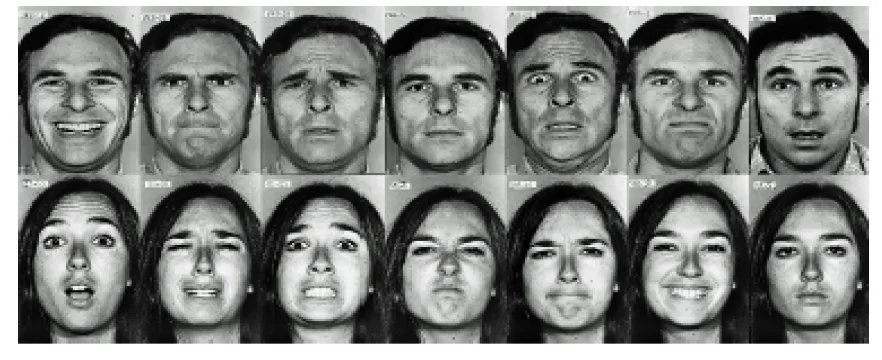
Arousal “Tells”
- Going up into a Hyperaroused State:
- Skin and muscle cues: tensed muscles, clenched fists, curling of toes, cooling skin, flushed skin
- Facial cues: increased muscle movement and contraction, tightening around mouth and cheeks, jutting/clenched jaw
- Eye cues: dilated pupils, glaring
- Breathing cues: rapid in chest
- Postural cues: Straightening, lengthened neck, raised chin, increased limb movement
- Gestural cues: increased, faster, sharp, bird-like jerky head, holding stomach (dyspepsia, from undigested food)
- Vocal cues: loud, shrill, booming, fast, staccato, high pitch, pleading sound
- Going down into Hypoaroused State:
- Skin and muscle cues: striated muscles loosen, digits relax, warming skin, pale skin, leaning to a side or forward or back
- Facial cues: decreased muscle movement and tone, mouth and cheek pads remain still, droopy expression
- Eye cues: constricted pupils, dimming
- Breathing cues: slow from diaphragm
- Postural cues: slumping, head down, elbows resting on knees, body tilting to left or right
- Gestural cues: fewer, slower, holding stomach (nausea, from digesting fluids), holding head (headache, ringing ears), wiping spittle from nose
- Vocal cues: monotone, muffled, inaudible, slow, low pitch, resignation sound